
Q: Zimbabwe exited the Africa Cup of Nations with a single point from three matches. What does this outcome mean for local football?
A: The immediate emotion is, of course, disappointment and pain. As a football-loving nation, we always want to compete strongly and progress further at major tournaments. That feeling is real and it is shared by all of us — administrators, players, technical staff and supporters.
However, when we move beyond the initial emotion and reflect more deeply, what we see is a team that has the makings of a strong future Warriors side. There were clear moments of competitiveness, organisation, and belief. With better planning, stronger coordination and sustained support, this is a team that can qualify again and perform better at future tournaments.
At this stage, it is important not to rush to conclusions. We will allow the technical team to submit their full reports before engaging in detailed public analysis. Decisions must be informed, structured, and guided by evidence rather than emotion.
Q: Traditionally, Zimbabwe’s response to AFCON disappointment has been to overhaul the team and change the coach. What will ZIFA do differently this time?
A: One of the lessons we have learned over time is that reactionary decisions do not build sustainable success. In this cycle, ZIFA entered into a one-year contract with the head coach, precisely to allow for structured review and accountability. Our approach now is to conduct a comprehensive post-tournament assessment. This review will cover every aspect of the campaign — pre-tournament planning, administration and logistics, technical preparation, on-field performance and player welfare. The objective is to identify what worked, what did not and what must improve.
Changing personnel without addressing systemic issues does not move football forward. One commentator once said we cannot keep changing the actors without changing the script. We need to work on our football system and make it one that produces results, instead of hoping for the best, and that is our plan. What will be different this time is that lessons drawn from this AFCON will be deliberately fed into future programmes and planning, rather than being lost in the emotion of the moment.
Q: With AFCON now behind us, what major competitions is ZIFA preparing for next?
A: Our focus immediately shifts to the road ahead. There are important competitions on the horizon, including the African Games, the Women’s Africa Cup of Nations, the Olympic pathway, the 2027 Africa Cup of Nations — whose qualification rounds begin in March — and, in the longer term, the 2030 FIFA World Cup. We also have the regional COSAFA tournaments for all national team ages from schools to the senior teams both male and female. We have a lot of football to look ahead to and we must be competitive in all spaces.
Each of these competitions requires careful planning, early preparation, and alignment across technical, administrative, and commercial structures. What we are committed to is continuity — ensuring that each tournament feeds into the next, rather than starting from zero every cycle.
Q: How will lessons from this AFCON campaign influence preparation for future tournaments?
A: This AFCON has provided valuable lessons, both on and off the field. We are happy we managed to utilise every FIFA international break and we had a good camp ahead of the tournament, but we will need to create more time for the technical team to be with players. Logistically, this tournament was a success and we will look to improve as we learn from CAF and from federations who have been very successful such as Morocco, South Africa and Egypt.
We want a national team programme that is predictable, professional and respected — one that allows players to focus on performance rather than uncertainty. That is the standard we are working towards. We also need to ensure our players face high pressure games with high quality opponents at every opportunity we get.
Q: What message do you have for supporters who are frustrated and disappointed?
A: I understand the frustration. Football evokes deep emotion because it represents national pride. My message to supporters is that your passion matters, and your expectations are valid. At the same time, progress requires patience and unity. We are building something that must endure beyond one tournament. If we remain committed to structure, accountability and long-term planning, Zimbabwean football will compete with confidence and consistency on the continental and global stage.
Q: Beyond AFCON, what is your overarching focus for Zimbabwean football?
A: 2026 is about consolidation and delivery. In 2025, we focused on stabilising governance, restoring credibility and rebuilding key systems. The year ahead is about making those systems work consistently and visibly. Our priority is to deepen youth development, strengthen women’s football, professionalise our competitions and ensure that our national teams are supported sustainably and responsibly. We want progress that can be measured, felt and sustained.
Q: Youth development has featured prominently in your messaging. What will change practically in 2026?
A: Youth development moves from intention to execution in 2026. The launch of the Roots Impact programme will see each province required to set up a minimum of four junior provincial teams, which will compete in an inter-provincial league, form which national team representatives will be selected. This is our new way of taking the game to everyone and ensuring we begin to build a national style of play. Our goal is to ensure that young players across the country are seen, tested, and supported.
Q: Women’s football has gained momentum. How will ZIFA build on this in 2026?
A: Women’s football is not a side programme; it is central to our development strategy. In November 2025 we launched the Women Football Strategy, in which we detailed the pathway that will lead women’s football to the top. Therefore, in 2026, we will focus on strengthening league structures, expanding competitive platforms for girls, and supporting women in leadership roles within football administration. Tournaments such as the CAF Girls Integrated Football Tournament, which we hosted in December in Norton, have shown what is possible when opportunity meets talent. Our task is to make those opportunities consistent and accessible across all regions.
Q: What are ZIFA’s plans regarding national teams in 2026?
A: Our approach to all national teams is built on sustainability, preparation, and professionalism. We want predictable calendars, early planning, and clear technical direction. In 2026, we will continue strengthening technical structures by appointing technical teams for teams still without these teams. We will roll out more training programmes to support coaches, and we will ensure that player welfare remains central. The objective is to avoid crisis-driven preparation and instead operate with clarity and discipline. National teams should reflect stability, not uncertainty.
Q: Governance reform has been a major theme of your tenure. What should stakeholders expect in 2026?
A: Good governance is not a once-off event; it is a culture. In 2026, we will continue strengthening administrative capacity, enforcing accountability, and ensuring that roles and responsibilities are clear across the Association. We are investing in professional administration, sound financial controls, and transparent decision-making. When governance is strong, football can flourish without unnecessary distractions. Therefore, from the national set up to the regions and districts, we will be enforcing stringent management of resources for the good of the game.
Q: Refereeing has often been a contentious issue. What changes are planned?
A: This year, we will pilot the use of the Video Assistant Referee, (VAR) in the local league as we target catching up with top administrations in the region and beyond. Refereeing is fundamental to the integrity of the game. In 2026, our focus is on training, performance monitoring and accountability. We want referees who are confident, well-prepared and supported, but also held to high standards.
Decisions will not always please everyone, but professionalism and consistency must always guide officiating. Credible competitions require trusted officials.
Q: Commercial sustainability is key for modern football. How is ZIFA approaching this in 2026?
A: We are building a commercial strategy that is aligned with national identity, innovation, and long-term value. We managed to get started with some key commercial partners as seen in the run up to AFCON and we will be expanding these and building targeted partnerships that will allow for the growth of the game in from junior level for both men and women. In 2026, we will deepen partnerships, grow sponsorship portfolios and strengthen our in-house commercial capabilities. The aim is to reduce reliance on crisis funding and ensure that football activities are supported through structured, predictable revenue streams. Sustainability is what allows development to continue even in difficult times.
Q: Legacy financial issues remain a concern. How will ZIFA address these going forward?
A: We are fully aware of the reputational damage caused by unpaid obligations from previous administrations. In 2026, we will continue engaging affected parties openly and responsibly. Our approach is structured, transparent and solutions-oriented. Clearing these issues is essential — not only for credibility, but for healing relationships within the football family. We will start with what we are able as a show of commitment. It is not good for people who sacrificed their time and skills to carry the national football team forward, to feel like they made a mistake in serving football.
Q: What message do you have for stakeholders as ZIFA enters 2026?
A: My message is one of unity, patience, and shared responsibility. Football belongs to all of us — administrators, players, coaches, clubs, sponsors, media and supporters. Progress takes time, but direction matters. We are building systems that will outlive individuals and administrations. If we remain united and committed to the long-term vision, Zimbabwean football will rise.
Q: Finally, what should success look like at the end of 2026?
A: Success will not be defined by a single result, but by visible improvement across the ecosystem. More young players playing competitive football. Stronger women’s competitions. Stable leagues. Professional administration.
National teams that prepare with dignity and confidence.
If, by the end of 2026, stakeholders feel that football is moving forward with purpose and integrity, then we will know we are on the right path. Our challenge is to leave a legacy that benefits future generations of football players and makes football both viable and safe. Our actions this year will be directed towards that goal.
More News
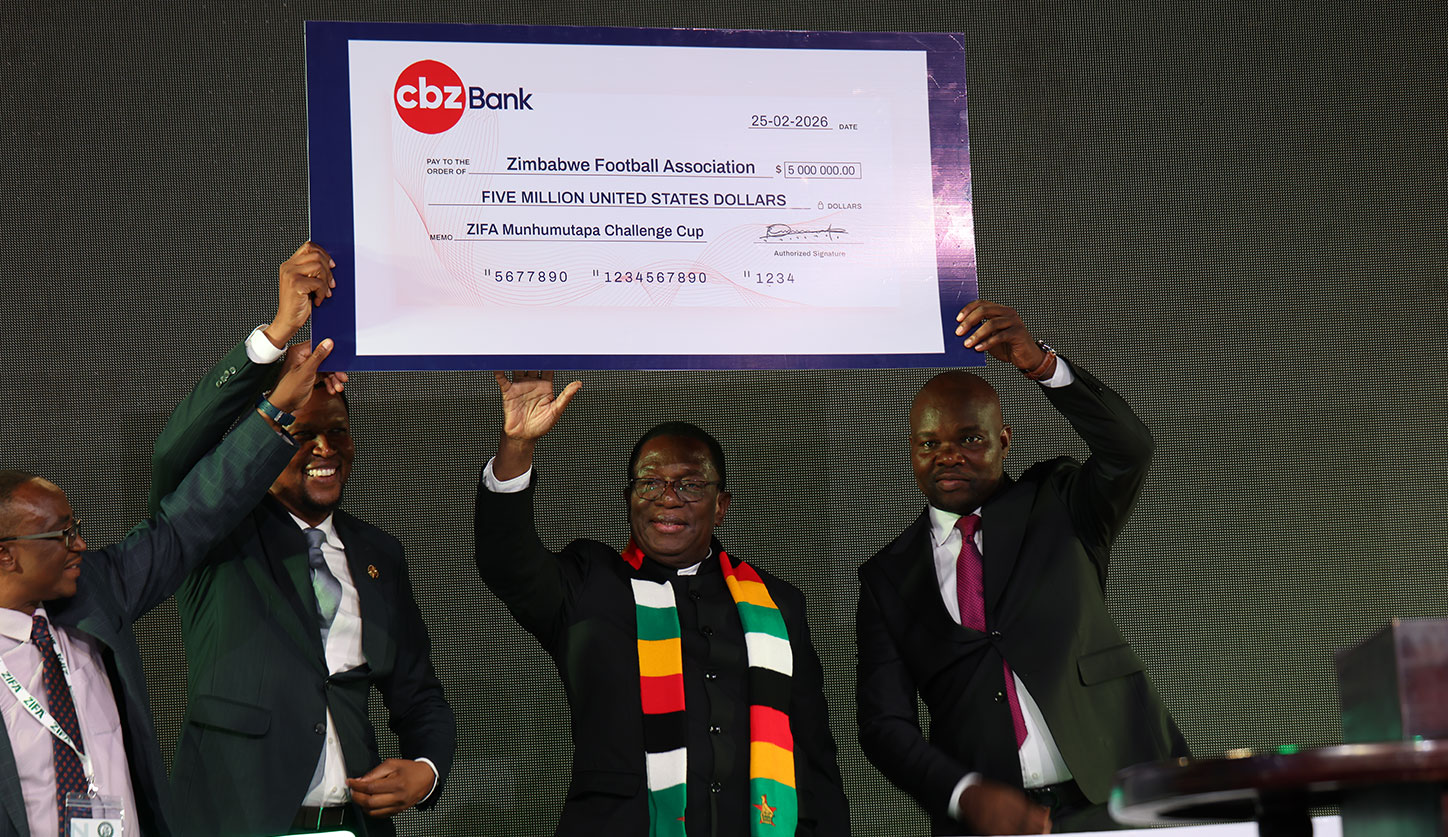
ZIFA Munhumutapa Challenge Cup launched!
Wed 4 Mar 2026
Zimbabwean football has taken a historic step forward following the official launch of the ZIFA Munhumutapa Challenge Cup – a flagship national knockout competition set to reshape the domestic game through unprecedented investment, nationwide inclusion and renewed belief in the power of football to unite and uplift. The glittering launch, held at the Celebration Centre […]

Zimbabwe Football Association 2026 © All Rights Reserved