

Football is more than what happens between the touchlines. Behind every matchday is structure, planning, governance and accountability. That is where Club Licensing comes in.
The Zimbabwe Football Association (ZIFA), in line with FIFA and CAF regulations, implements the Club Licensing system to ensure that clubs operate professionally, transparently and sustainably. Simply put, Club Licensing is a quality assurance system for football clubs. It sets minimum standards that clubs must meet in order to participate in organised competitions.
But what exactly does that mean? Let us break it down into the A–B–C of Club Licensing.
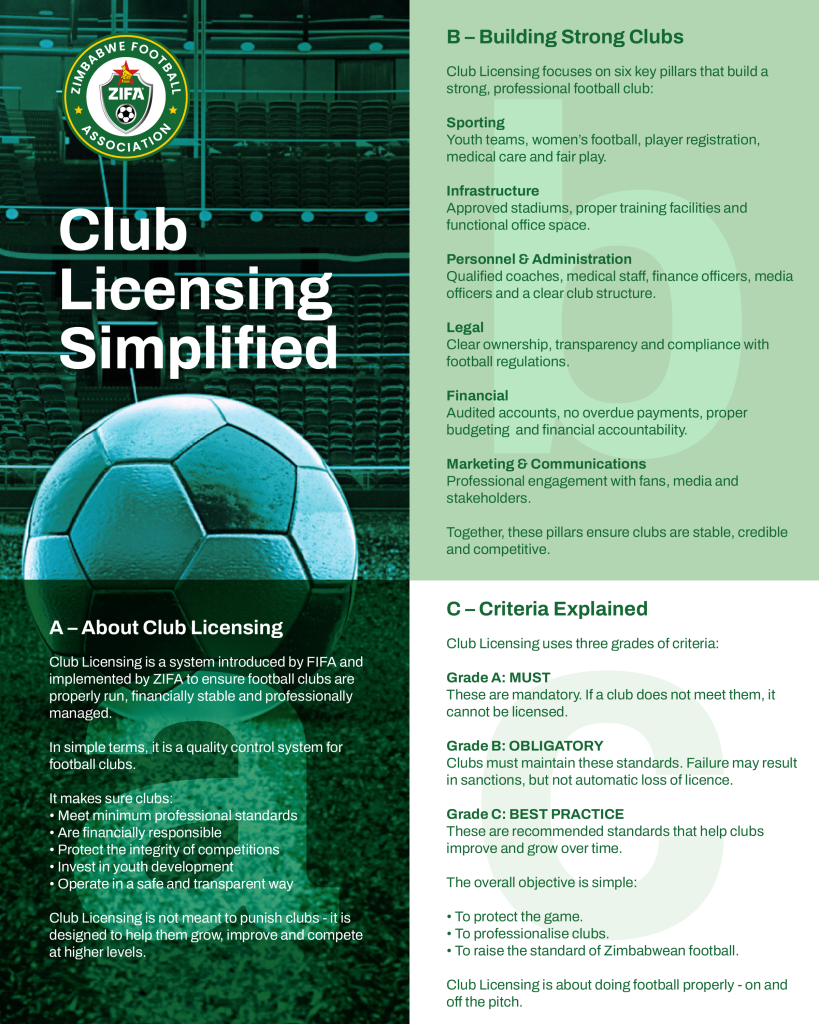
A – About Club Licensing
Club Licensing is designed to improve the overall standard of the game. It ensures that clubs are not only competitive on the pitch, but also well-managed off it.
The system promotes:
• Good governance
• Financial discipline
• Youth development
• Safe and secure match environments
• Integrity and transparency in competitions
It is not a punitive tool. Rather, it is a framework that helps clubs grow responsibly and position themselves for long-term success.
B – Building Strong Clubs
Club Licensing is built around key pillars that form the foundation of a professional football club.
Sporting criteria ensure clubs invest in youth development, register players properly, provide medical care and support women’s football.
Infrastructure criteria require approved stadiums, training facilities and functional office space to support operations.
Personnel and administrative criteria ensure that clubs have qualified coaches, medical staff, finance officers and administrators in place.
Legal criteria safeguard the integrity of competitions through transparent ownership structures and compliance with football regulations.
Financial criteria promote accountability through audited financial statements, responsible budgeting and the settlement of player and staff obligations.
Together, these pillars ensure that clubs are stable, credible and capable of competing at higher levels.
C – Criteria Explained
Club Licensing criteria are divided into three categories:
Grade A – Must. These are mandatory requirements. Failure to meet them means a licence cannot be granted.
Grade B – Obligatory. These standards must be maintained, and failure to comply may result in sanctions.
Grade C – Best Practice. These are recommended standards that encourage continuous improvement.
The ultimate goal of Club Licensing is clear: to professionalise Zimbabwean football, protect the integrity of competitions and raise the quality of the game across all levels.
As ZIFA continues to implement the Club Licensing framework, stakeholders are encouraged to view it not as a hurdle, but as a pathway — a structured journey towards stronger clubs and a stronger football nation.
Because when clubs are built properly, the entire game benefits.
More News
ZIFA REAFFIRMS COMMITTMENT TO CLUB LICENSING
Tue 17 Feb 2026
ZIFA wishes to reaffirm that the implementation of Club Licensing Regulations will proceed as partof our collective commitment to strengthening governance, professionalism and competitivenesswithin Zimbabwean football. While we recognise the concerns raised by stakeholders and remainopen to constructive engagement on timelines and transitional mechanisms, the principles underpinning Club Licensing are non-negotiable – financial discipline, proper […]

Zimbabwe Football Association 2026 © All Rights Reserved